iTech Gaming

Be ready with iTech Gaming for your next battle & choose your next Console For your gaming center at home, or a gaming laptop for go-anywhere excitement. Either way the right gaming accessories can mean the difference between a happy good win, and a “hard luck” to losers.

Now, if you already have a gaming desktop, then adding a Larger monitor with high resolution and refresh rates, a keyboard and a Gaming mouse is a great start to see & feel the world around you.

Get Your First Audible Book for Free with a 30-Day Trial!

Cheerful young Hispanic female in white tank top listening to music via headphones and reading book while sitting on chair in park

As busy individuals, it can be tough to find the time to sit down and read a physical book. But what if there was a way to consume your favorite books on the go, without having to sacrifice your busy schedule? Enter Audible – the world’s leading provider of audiobooks.

Discover the Convenience and Enjoyment of Audiobooks with Audible

With Audible, you can enjoy a wide selection of audiobooks across all genres, as well as a convenient listening experience that allows you to consume books anytime, anywhere. Whether you’re commuting to work, running errands, or working out at the gym, you can listen to your favorite books and make the most of your time.

Get Your First Audiobook for Free with a 30-Day Trial

And the best part? You can try Audible out for free with a 30-day trial. That’s right – you can get your first audiobook for free when you sign up for a free trial of Audible. This is the perfect opportunity to test out the service and see if it’s right for you.

So why wait? Don’t miss out on this amazing opportunity to discover the convenience and enjoyment of audiobooks with Audible. With a wide selection of audiobooks and a convenient listening experience, Audible is the perfect choice for busy individuals and avid readers alike. Sign up for a free trial today and get your first audiobook for free. Try it out now and see why Audible is the world’s leading provider of audiobooks.

See Also: Best Wireless Earbuds Under $150 (2026 Guide)

Get Your First Audible Book for Free with a 30-Day Trial! Read More »

Find the Perfect Laptop with Our Comparison Tool

Laptop comparison tool on a computer screen

Simplify Your Laptop Search with a Comparison Tool

Are you tired of spending hours online trying to compare different laptops to find the perfect one? A laptop comparison tool can simplify your search and help you make an informed decision.

Save Time and Effort

Laptop shopping can be a time-consuming and frustrating process. There are so many options to choose from, and it can be difficult to know which one is the best fit for your needs. A laptop comparison tool can help you narrow down your options and save you the effort of manually comparing different laptops. Simply enter your preferences and the tool will generate a list of laptops that meet your criteria. This can save you hours of time and effort and help you focus on the laptops that are most likely to meet your needs.

Compare Key Features and Specs

When shopping for a laptop, it’s important to compare key features and specs to ensure that you are getting the best value for your money. A laptop comparison tool can help you quickly and easily compare the processor, graphics card, RAM, storage, and other key specs of different laptops. This will help you make an informed decision about which laptop is the best fit for your needs.

For example, if you are a gamer, you will want a laptop with a powerful processor and graphics card to handle the demands of modern games. On the other hand, if you are a writer or a student, you may be more interested in a laptop with a long battery life and a comfortable keyboard. A laptop comparison tool can help you compare the key features and specs of different laptops to find the one that meets your specific needs.

Find the Best Deals

A laptop comparison tool can also help you find the best deals on laptops. Many comparison tools allow you to filter by price, so you can easily find laptops within your budget. Some even include reviews and ratings from other customers, so you can see which laptops are the most popular and well-reviewed. This can save you money and help you find the best value for your investment.

Make an Informed Decision

Ultimately, a laptop comparison tool can help you make an informed decision about which laptop is the best fit for your needs. With all of the key features and specs in one place, you can easily compare different laptops and choose the one that meets your needs and budget.

Using a laptop comparison tool can also help you avoid making a rushed or uninformed decision. With so many options available, it can be tempting to choose the first laptop that seems good enough. But a laptop is a significant investment, and it’s important to take the time to research and compare different options to ensure that you are getting the best value for your money. A laptop comparison tool can help you do just that, so you can make an informed decision with confidence.

So if you’re ready to simplify your laptop search and make an informed decision, give a laptop comparison tool a try. You’ll save time and effort, and you’ll be able to find the perfect laptop for you.

See Also the “Are gaming laptops worth it” GUIDE

Find the Perfect Laptop with Our Comparison Tool Read More »

Is a 144Hz Laptop Worth It? 144Hz vs 165Hz vs 240Hz, and the GPU You Need (2026)

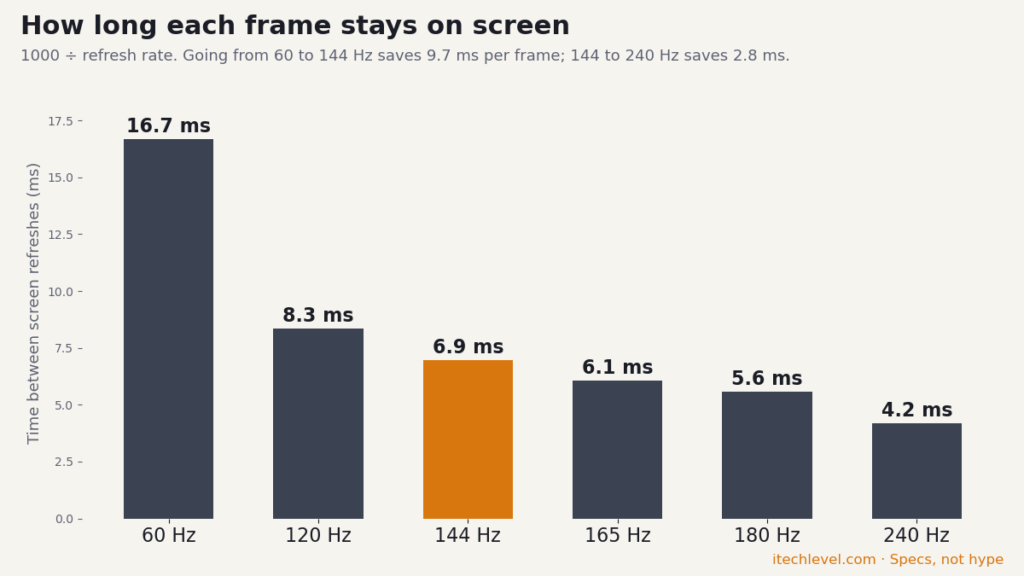
Bar chart of frame time by laptop refresh rate, 60 Hz to 240 Hz

Short answer: yes, a 144Hz screen is worth it on a gaming laptop: each frame stays on screen for 6.9 ms instead of 16.7 ms at 60Hz, and that’s the jump you notice most. But in 2026, 144Hz is the floor, not a feature. Most budget gaming laptops now ship 165Hz or 180Hz panels, and you only see the benefit if your GPU can actually push 144 frames per second. A 240Hz screen is worth paying for only if you play competitive shooters on a full-power RTX 5070 or better.

How we put this together: frame times are simple math, screen specs come from the makers, and GPU power comes from our laptop GPU power database. It is not based on hands-on testing by iTech Level. See how we choose products.

144Hz vs 165Hz vs 240Hz at a glance

Frame time is simply 1000 divided by the refresh rate. The laptops listed are ones we cover, with the screens their makers and our guides list for them.

Refresh rateFrame timeWhere you’ll find it in 2026Best for
60 Hz16.7 msOffice and budget non-gaming laptopsEveryday work
120 Hz8.3 msOLED thin-and-lights: ASUS Zephyrus G14 (3K OLED), HP Omen Transcend 14Creators and travel gaming
144 Hz6.9 msBase screens on the MSI Katana and Cyborg 15 (1920×1080)The gaming minimum
165 Hz6.1 msAcer Nitro V 15 (RTX 5050), many RTX 5060 and 5070 laptops (1080p to 1600p)Most buyers
180 Hz5.6 msAcer Nitro V 16S AI (1200p or 1600p)Most buyers
240 Hz4.2 msLenovo Legion Pro 5i Gen 10 (IPS), Acer Predator Helios Neo 16 AI, ASUS ROG Strix SCAR 16 (Mini-LED)Competitive shooters
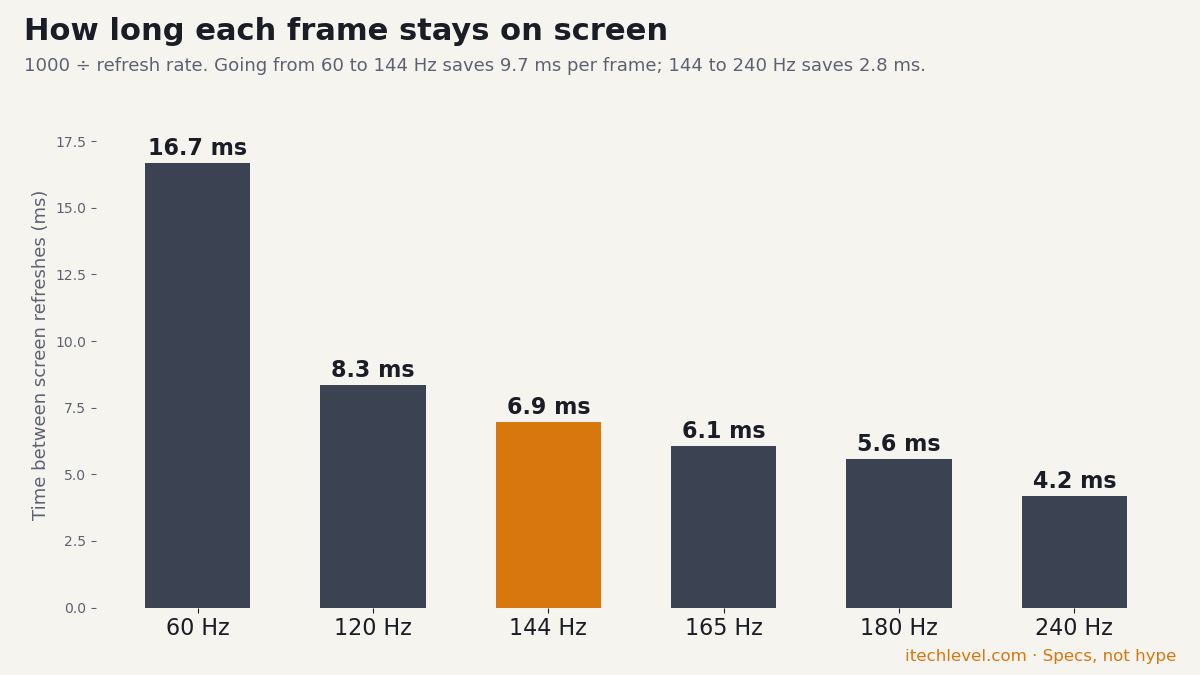
Bar chart of frame time by refresh rate: 60 Hz 16.7 ms, 120 Hz 8.3 ms, 144 Hz 6.9 ms, 165 Hz 6.1 ms, 180 Hz 5.6 ms, 240 Hz 4.2 ms
The gains shrink fast above 144Hz: 60 to 144Hz saves 9.7 ms per frame, 144 to 240Hz saves 2.8 ms.

What a 144Hz screen actually changes

A 60Hz screen redraws the image 60 times a second; a 144Hz screen does it 144 times. In games, that means smoother camera turns, easier tracking of moving targets and less blur when you flick the mouse. Outside games, scrolling and moving windows also look smoother, though that alone isn’t worth paying for.

Three things decide whether you actually get that smoothness:

  • Your frame rate. A 144Hz screen showing 70 fps looks like 70 fps. The GPU has to keep up, which is why GPU power matters more than the number on the screen (next section).
  • G-SYNC or adaptive sync. When the frame rate drops below the refresh rate, G-SYNC keeps motion smooth without tearing. Many of our picks list it, for example the Legion Pro 5i Gen 10’s 240Hz panels.
  • A MUX switch or Advanced Optimus. It sends frames straight from the NVIDIA GPU to the screen, which adds frames in many games. NVIDIA cites 11% to 27% more frames from Advanced Optimus in its own figures. See our gaming laptops with a MUX switch.

The GPU decides whether you’ll see 144 fps

The same GPU name can run at very different power levels depending on the laptop, and power is what turns into frames. Across 238 laptop configurations in our laptop GPU power database (maker spec sheets from Acer, Lenovo, MSI, ASUS, Gigabyte and Razer), this is the maximum GPU power each RTX 50 chip gets:

GPUMax GPU power (lowest to highest laptop)Configurations
RTX 505045–115 W44
RTX 506055–115 W64
RTX 507060–115 W63
RTX 5070 Ti115–140 W27
RTX 5080115–175 W24
RTX 5090130–175 W16

An RTX 5060 at 55 W and one at 115 W are not the same laptop. For high settings at 144Hz or more in newer games, look for an RTX 5060 or RTX 5070 running at the full 115 W; an RTX 5050 suits lighter games and esports titles at lower settings. Our best RTX 5060 laptops and best RTX 5070 laptops guides list the GPU power of every pick.

Which refresh rate should you buy?

How to check and set your laptop’s refresh rate

  1. Open Settings → System → Display → Advanced display (Windows 11).
  2. Under Choose a refresh rate, pick the highest value. Some laptops ship set to 60Hz.
  3. If you see Dynamic, Windows drops to 60Hz for desktop work and goes up to full speed in games and scrolling, which saves battery (Microsoft explains the setting).
  4. Plug in when gaming: many laptops lower GPU power on battery, so you won’t reach 144 fps unplugged.

Frequently asked questions

Is 144Hz good for a gaming laptop?

Yes. 144Hz shows a new frame every 6.9 ms instead of every 16.7 ms at 60Hz, which makes motion and aiming look much smoother. In 2026 it's the entry level: most budget gaming laptops now ship 165Hz or 180Hz screens, so treat 144Hz as the minimum, not a premium feature.

Is 165Hz better than 144Hz?

Slightly. 165Hz cuts the frame time from 6.9 ms to 6.1 ms, a difference most people can't see. Don't pay extra for 165Hz over 144Hz; pick the laptop with the better GPU power and screen quality instead.

Is 240Hz worth it on a laptop?

Only for competitive shooters, and only with a GPU that can reach 200+ fps in your games. The frame time drops from 6.9 ms (144Hz) to 4.2 ms (240Hz), but 240Hz laptops mostly cost $2,000 or more, so most players get more from a stronger GPU at 165Hz.

Does a 144Hz screen use more battery?

Yes, refreshing the panel more often uses more power. Windows 11's Dynamic refresh rate option drops the screen to 60Hz for everyday work on laptops that support it, and you can set 60Hz manually when you're on battery.

How do I check my laptop's refresh rate?

In Windows 11, open Settings, System, Display, Advanced display, and look at 'Choose a refresh rate'. Pick the highest value listed; some laptops ship set to 60Hz.

Is a 144Hz Laptop Worth It? 144Hz vs 165Hz vs 240Hz, and the GPU You Need (2026) Read More »

Best Small Gaming Laptops (2026): 4 Smallest Picks You Can Actually Buy

Close-up of a gaming laptop keyboard with green backlit keys

Quick answer: the best small gaming laptop is still the ASUS ROG Zephyrus G14 (2025) (1.50 kg, OLED, RTX 5060 or 5070), though it’s often sold by resellers at a markup, so check the seller. The smallest gaming machine is the ASUS ROG Flow Z13 (2025), a 1.20 kg gaming tablet. For the most graphics power in a 14-inch body, the Acer Predator Helios Neo 14 AI runs its RTX 5060 or 5070 at a full 115 W, at the cost of extra weight. Sizes come from the manufacturers’ spec pages and reviews; we compare published specs and reviews rather than running our own lab tests (how we choose).

See Zephyrus G14 listings on Amazon →

How we put this together: this guide is built from manufacturer specs and from published reviews and tests, linked where we use them. It is not based on hands-on testing by iTech Level. See how we choose products.

The smallest gaming laptops in 2026 weigh between 1.2 and 1.6 kg (2.7 to 3.5 lb), about the same as a thin ultrabook, and still run modern games on a dedicated or high-end integrated GPU. If you want to game on a train, in a dorm or from a hotel desk without carrying a 17-inch brick, this is the class to look at. The catch in late 2026: several of the best-known small gaming laptops are hard to buy new, so this guide only recommends ones you can actually get.

Next sale: Black Friday

Prime Big Deal Days has ended. Black Friday is November 27, 2026, and Cyber Monday is November 30. Amazon's Black Friday deals often start a few days early. Some Amazon Black Friday deals are for Prime members only. New members can start a free Prime trial (eligible customers; it becomes paid unless you cancel). Our picks are chosen on year-round value, not just sale pricing; tap any link to see today's price.

Smallest gaming laptops ranked by size

Sorted from lightest to heaviest. Thickness ranges cover the thinnest and thickest point of the chassis. Laptops marked “hard to find” were hard to buy new at a sensible price in the US in early October 2026.

LaptopScreenWeightThicknessAvailability
1. ASUS ROG Flow Z13 (2025)13.4-inch 2-in-1 tablet1.20 kg (2.65 lb), tablet only1.30–1.49 cmPick
2. ASUS TUF Gaming A14 (RTX)14-inch1.46 kg (3.22 lb), 2024 model1.69–1.99 cmHard to find (see below)
3. ASUS ROG Zephyrus G14 (2025/2026)14-inch1.50–1.57 kg (3.31–3.46 lb)1.59–1.83 cmPick
4. Razer Blade 14 (2025)14-inch1.63 kg (3.59 lb)1.58–1.62 cm (thinnest)Hard to find
5. HP OMEN Transcend 1414-inchabout 1.63 kg (3.6 lb)about 1.8 cmHard to find
6. Acer Predator Helios Neo 14 AI14.5-inchabout 1.9 kg (4.1 lb)about 2.1–2.6 cmPick
7. Lenovo LOQ 15 (15AHP11, 2026)15.3-inch2.1 kg (4.6 lb)not stated on the listingPick

The first five are the genuinely small options. The Helios Neo 14 AI trades some of that portability for a full-power GPU, and the LOQ 15 is here for readers who would rather carry a bigger, cheaper laptop than pay extra for a small one.

Comparison at a glance

ProductKey specs
Best Overall
ASUS ROG Zephyrus G14
14-inch 3K OLED at 120Hz, RTX 5060 or 5070 at 100 W, 1.50–1.57 kg. G14 price & model guide →Check on Amazon
Smallest Overall
ASUS ROG Flow Z13 (2025)
13.4-inch 2.5K touchscreen at 180Hz, Ryzen AI Max+ 395, Radeon 8060S, 32GB, 1.20 kg tabletCheck on Amazon
Most GPU Power
Acer Predator Helios Neo 14 AI
14.5-inch 2.5K at 165Hz, RTX 5060 or 5070 at 115 W, Core Ultra 7 or 9, about 1.9 kgCheck on Amazon
Best Value (Bigger)
Lenovo LOQ 15 (15AHP11, 2026)
15.3-inch 1920×1200 at 165Hz, RTX 5060 at 115 W, Ryzen 7 250, 2.1 kgCheck on Amazon

Prices and sellers change often, so check the current price and who sells the laptop before you buy.

The picks

Best Overall: ASUS ROG Zephyrus G14 (2025 or 2026)

Still the best-balanced small gaming laptop, if you can find it at a fair price.

The Zephyrus G14 packs a 14-inch 3K OLED screen at 120Hz and an RTX 5060 or RTX 5070 into an aluminium chassis that weighs 1.50–1.57 kg and is 1.59–1.83 cm thick. ASUS’s official GPU power list rates the 2025 model’s RTX 5060 and 5070 at up to 100 W, a little below full power but a sensible balance for its size. The 2026 version keeps the same size with a brighter OLED (1,100 nits peak) and a 73Wh battery; our G14 price and model guide explains which year and configuration to look for.

The problem in October 2026 is finding one at a fair price: many G14 listings come from resellers, often with upgraded memory or storage at a markup. At reseller prices, the Helios Neo 14 AI below gives you more graphics power for less money; the G14 is worth the extra if a lighter, slimmer laptop and an OLED screen matter more to you. Check the seller and the exact configuration before you buy.

Pros

  • 3K OLED display at 120Hz
  • RTX 5060 or 5070 in a 1.5 kg aluminium chassis
  • Slimmer and lighter than the full-power 14-inch alternatives

Cons

  • Often hard to find at its list price
  • GPU limited to 100 W, below the 115 W of the Helios Neo 14 AI

See Zephyrus G14 listings on Amazon →

Smallest Overall: ASUS ROG Flow Z13 (2025)

The smallest gaming machine here: a 13.4-inch tablet with a detachable keyboard and graphics that reviewers compare to a laptop RTX 4070.

The ROG Flow Z13 is not a laptop in the usual sense. It is a 1.20 kg (2.65 lb), 1.3 cm thick Windows tablet with a kickstand and a detachable keyboard cover, built around AMD’s Ryzen AI Max+ 395. That chip has no separate graphics card; its integrated Radeon 8060S is strong enough that Notebookcheck found it neck-and-neck with the RTX 4070 Laptop GPU. The 13.4-inch 2.5K screen runs at 180Hz and supports touch and a stylus.

The Ryzen AI Max+ 395 version with 32GB of memory is often discounted. Note that some listings use the slightly cheaper Ryzen AI Max 390 instead, which has a smaller integrated GPU, so check the processor name. The trade-offs are price, a kickstand and keyboard cover that are less stable on your lap than a hinge, and graphics that still trail a full-power RTX 5070 in the heaviest games.

Pros

  • Smallest and lightest pick: 1.20 kg tablet, 1.30 cm thick
  • Integrated graphics close to a laptop RTX 4070
  • 2.5K 180Hz touchscreen with stylus support
  • Works as a tablet as well as a gaming PC

Cons

  • Expensive for its gaming performance
  • Kickstand and keyboard cover are awkward on a lap

Flaws but not dealbreakers

The 1.20 kg figure is the tablet alone; the keyboard cover adds a little. Without a dedicated GPU, expect to lower settings in the heaviest new games compared with a full-power RTX laptop.

Check on Amazon →

Most GPU Power for the Size: Acer Predator Helios Neo 14 AI

A full 115 W RTX 5060 or 5070 in a 14.5-inch body, if you can live with the extra weight.

Most small gaming laptops cut GPU power to keep heat in check. The Helios Neo 14 AI (PHN14-71) doesn’t: Acer’s official GPU power list rates its RTX 5060 and RTX 5070 at 115 W, the most in this guide. It comes with a Core Ultra 7 255H, RTX 5060, 16GB and a 14.5-inch 2.5K 165Hz screen, or a Core Ultra 9 285H, RTX 5070 and 32GB.

The cost is size. PCWorld’s review lists it at 4.14 lb (about 1.9 kg) and 1.02 inches thick, criticised the battery life and the keyboard, and concluded it’s “good, but just not good enough” next to the Zephyrus G14 for portability. We’d still pick it when the G14 is only available at reseller prices, since it gives you more graphics power for less.

Pros

  • RTX 5060 or 5070 at a full 115 W
  • Full 115 W RTX 5060 or 5070
  • RTX 5070 version includes 32GB of memory

Cons

  • About 1.9 kg: heavier and thicker than the G14
  • Battery life and keyboard criticised in reviews

Check the RTX 5070 version on Amazon →

Check the RTX 5060 version on Amazon →

The pick below is bigger. At 2.1 kg the LOQ 15 isn’t a small laptop; it’s here for readers who would rather carry a larger screen than pay extra for a compact one.

Best Value (Bigger): Lenovo LOQ 15 (15AHP11, 2026) with RTX 5060

A full-power RTX 5060 for much less, in a 15-inch body you can still carry.

If size isn’t critical, the 2026 LOQ 15 gets you a full-power GPU for much less than any small laptop here. Lenovo’s spec sheet lists its RTX 5060 at the full 115 W, with an AMD Ryzen 7 250 and a 15.3-inch 1920×1200 165Hz screen with 100% sRGB, in a 2.1 kg (4.6 lb) chassis. This version has 16GB of memory in a single stick and a 512GB SSD. It’s also our pick for a lighter laptop in the best gaming laptops under $1,200.

Pros

  • RTX 5060 at a full 115 W for less
  • 15.3-inch 16:10 screen at 165Hz with 100% sRGB

Cons

  • Not a small laptop (2.1 kg)
  • 512GB SSD and a single 16GB memory stick out of the box

Check on Amazon →

Small gaming laptops that are hard to find right now

These were picks in earlier versions of this guide. They’re still good laptops, but in early October 2026 they were hard to buy new at a sensible price:

  • Razer Blade 14 (2025): the thinnest 14-inch gaming laptop here (1.58 cm) with an RTX 5060 or 5070 at up to 115 W. Razer’s US store listed the RTX 5060 version at $2,299.99. Our Razer Blade 14 guide has the specs and what reviews say.
  • HP OMEN Transcend 14: a creator-friendly 14-inch with a 3K OLED, but it often comes as a pricey reseller bundle.
  • ASUS TUF Gaming A14 with an RTX GPU: the lightest clamshell in our ranking. ASUS rates the 2025 model’s RTX 5060 at 110 W, but some TUF A14 listings have a Ryzen AI Max+ 392 with integrated graphics and no RTX GPU, so read the listing carefully.

Even smaller: handheld gaming PCs

If a 1.2 kg tablet is still too big, the next step down is a handheld PC. The Steam Deck OLED (7.4-inch screen, about 640 g), ASUS ROG Xbox Ally X (7-inch, about 715 g) and Lenovo Legion Go 2 (8.8-inch, about 920 g) all run PC games, but they are built around a controller rather than a keyboard, with lower-power chips aimed at 800p to 1080p. They make great travel companions, but they don’t replace a laptop for work or keyboard-and-mouse games.

What to look for in a compact gaming laptop

  • GPU and its wattage: an RTX 5060 or better handles new games at 1080p. Small laptops often limit GPU power, from about 100 W in the Zephyrus G14 down to 60 W in some budget 14-inch models, so look the exact model up in our laptop GPU power database.
  • Integrated vs dedicated graphics: AMD’s Ryzen AI Max+ chips (Flow Z13, some TUF A14s) have strong integrated graphics and no RTX GPU. They’re good, but check which one a listing has.
  • Weight and thickness: under 1.6 kg is genuinely small; full-power 14-inch models like the Helios Neo 14 AI weigh closer to 1.9 kg.
  • Display: OLED panels give deeper blacks and higher contrast; 120Hz to 180Hz keeps games smooth.
  • Battery and charging: gaming drains any laptop in a couple of hours, so USB-C charging for light use on the go is a useful extra.
  • Who’s selling it: small gaming laptops are often sold by resellers with “upgraded” configurations at a markup. Check the seller and compare with the standard configuration.

Our verdict

The ASUS ROG Zephyrus G14 is still the best small gaming laptop if you find one at a fair price, and the ASUS ROG Flow Z13 is the pick if you want the smallest machine possible and can live with a tablet. With the G14 mostly reseller-priced right now, the Acer Predator Helios Neo 14 AI is the 14-inch laptop we’d actually buy for gaming today: more GPU power for less money, at the cost of about 400 g. If size matters less than price, the Lenovo LOQ 15 with a full-power RTX 5060 costs much less.

Frequently Asked Questions

What is the smallest gaming laptop in 2026?

The ASUS ROG Flow Z13 (2025) is the smallest gaming machine in this guide: a 13.4-inch tablet that weighs 1.20 kg (2.65 lb) and is 1.3 cm thick, with a detachable keyboard. Among traditional clamshells, the ASUS TUF Gaming A14 (1.46 kg) and the ASUS ROG Zephyrus G14 (1.50–1.57 kg) are the lightest, though the RTX version of the TUF A14 was hard to find new in October 2026.

What is the best small gaming laptop in 2026?

The ASUS ROG Zephyrus G14 is the best-balanced small gaming laptop, with a 3K OLED screen and an RTX 5060 or 5070 in a 1.5 kg body. It’s often sold by resellers at a markup, and at those prices the Acer Predator Helios Neo 14 AI, with a full 115 W RTX 5060 or 5070, is the better buy.

Is the ASUS ROG Zephyrus G14 worth the price?

At or near its normal price, yes: it’s lighter and slimmer than other 14-inch gaming laptops with an RTX 5060 or 5070, and its OLED screen is excellent. At reseller prices, a full-power laptop like the Helios Neo 14 AI gives you more performance for less.

Do mini gaming laptops sacrifice performance compared to larger models?

Often, yes. Many small laptops limit GPU power to manage heat, from about 100 W in the Zephyrus G14 down to 60 W in some budget 14-inch models, while larger laptops usually run the same GPU at 115 W. The Helios Neo 14 AI is an exception, with a 115 W RTX 5060 or 5070, at the cost of extra weight. Check the exact model in our laptop GPU power database.

What GPU should I look for in a compact gaming laptop?

Aim for at least an RTX 5060 for smooth 1080p gaming, and check its wattage, since a power-limited GPU can be much slower. AMD’s Ryzen AI Max+ chips, as in the Flow Z13, have strong integrated graphics instead of an RTX GPU.

Is there anything smaller than a mini gaming laptop?

Yes. Handheld gaming PCs such as the Steam Deck OLED (about 640 g), ROG Xbox Ally X (about 715 g) and Legion Go 2 (about 920 g) run PC games on a 7- to 8.8-inch screen. They are more portable than any laptop but use lower-power chips and have no keyboard.

What is the lightest RTX 5070 laptop?

Of the laptops in this guide, the ASUS ROG Zephyrus G14 (2025/2026) at 1.50–1.57 kg (3.31–3.46 lb), with its RTX 5070 rated at 100 W. The Razer Blade 14 (2025) is next at 1.63 kg (3.59 lb) with an RTX 5070 at up to 115 W, but it’s hard to find at a sensible price. The Acer Predator Helios Neo 14 AI also has a full 115 W RTX 5070 and weighs about 1.9 kg (4.1 lb). Our laptop GPU power database lists the wattage for every model.

Related guides

If you’re shopping on a tighter budget, see our roundup of the best budget gaming laptops under $1,200, and our honest take on whether budget gaming laptops are worth it in 2026 given this year’s price increases.


Best Small Gaming Laptops (2026): 4 Smallest Picks You Can Actually Buy Read More »

Are Desktops Better Than Laptops?

A warm and inviting workspace displaying a lit lamp and computer monitor on a tidy desk.

For much of the century there’s been an ongoing debate about whether are desktops better than laptops. There have been passionate advocates on both sides of the debate.

A warm and inviting workspace displaying a lit lamp and computer monitor on a tidy desk.
Photo by Mateusz Dach on Pexels.com

Are Desktops Better than Laptops?

For those who opt for desktops, they love the stability, and strength that these computers offer. Desktops have the space to include all of the latest Hardware and an ample amount of cooling no matter how robust the system is. This cooling option will be so important to the computer & can help the powerful components to make the system faster, more reliable, and able to take on any task.

Desktops also have a reputation for lasting longer. They are highly upgradeable. Components can be taken out easily and replaced with newer more powerful versions without having to purchase an entirely new unit. Computer repairs on a desktop is much simpler than a laptop. The parts are readily accessible for a computer technician and swapping out those parts is extremely easy. Therefore, if you will need computer support, a desktop will be a better choice than a laptop.

Desktop Downsides

Of course the downside of a desktop is that it is a large, stationary, and if there’s a need for repair, it can be cumbersome to transport to the computer repair shop. However whether it is a hard drive repair or the repair of some other vital component, the desktop will be less expensive and parts will be more readily available than with the laptop.

What if a desktop isn’t better than laptop?

Laptop computers have become more powerful, better made, and lighter. some laptops can almost rival the performance of desktop computers, and in fact only the top of the line desktop computers leave the best laptops in the dust. Laptops have a great edge over desktop computers because they are portable.

You can take them anywhere you need to go from a coffee shop, to a morning commute on the subway, and even on vacation, and always be ready to get your work done. This level of portability fits into the average workers lifestyle and maybe an indispensable feature when purchasing a computer.

Laptop Downsides

No matter how powerful the laptop is, there will always be compromises when you purchase one. Because laptops are designed to be light in weight and portable, they use components that are specifically designed for their size and weight. These components will never be as robust as those found in the desktop and you will therefore sacrifice speed and in some cases durability. For instance the higher the clock speed of a computer’s Central processing unit, the more heat it will generate.

Heat is dissipated in a computer by fans and heat sinks. Because a laptop has limited space, the amount of fans and heat sinks are also limited. As a result a laptop will be limited in its speed. Laptops are all so much more expensive to be fixed than desktops. When you’ll need laptop screen repair, laptop keyboard repair or some other laptop fix, the cost might make you want to reconsider your decision and even begin thinking of buying a new one. There’s also the potential for parts Repairing taking a long time. Many repair shops will have to send out for parts for your laptop causing you headaches and potentially lost work.

The Conclusion

In the end, your decision about whether are desktops better than laptops, should be made based on your needs and lifestyle. If you are able to do the vast majority of your work in one location and you need a powerful and stable computer, a desktop still might be your best option. However if you are constantly on the go, and need to be able to set your computer up anywhere and get to work, a laptop is by far the right way to go.

by Tyron Tromp

See Also our best mini gaming laptops guide.

Are Desktops Better Than Laptops? Read More »